Phone
Add
2026-04-20
Source:BioPharma Dive
Share:
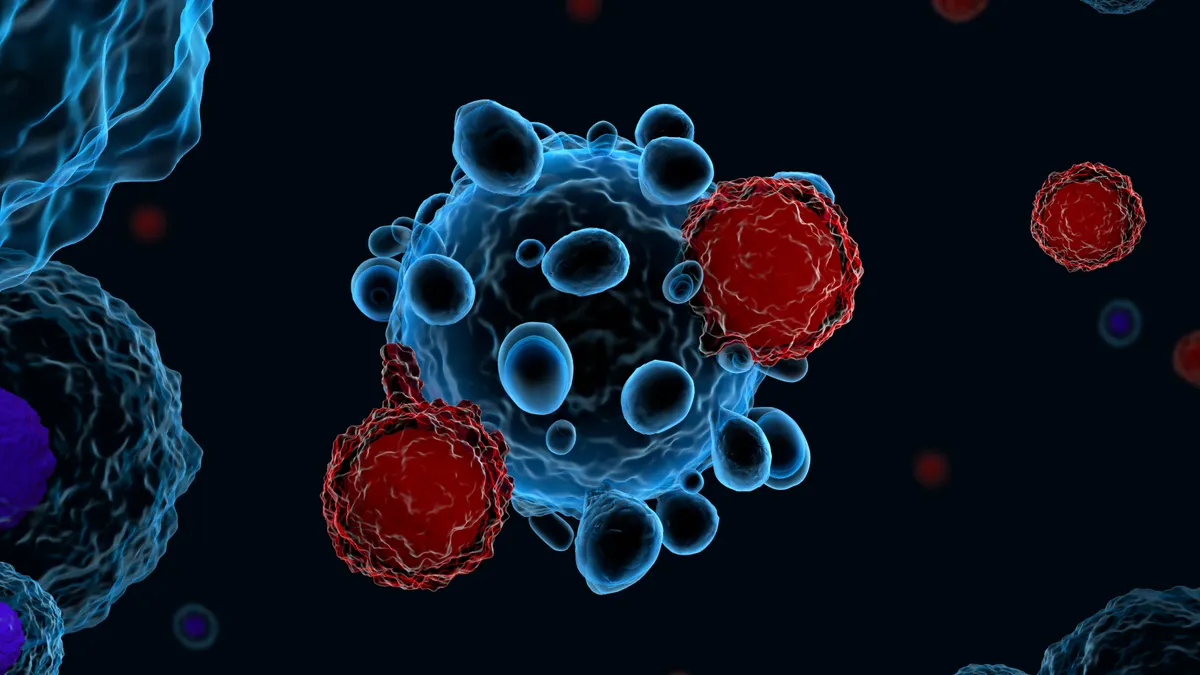
Some cell therapies have been genetically engineered to target a protein called BCMA, which is present on multiple myeloma cells. Getty Images
Eli Lilly agreed on Monday to acquire the privately held biotechnology company Kelonia Therapeutics in a deal potentially worth up to $7 billion, a move that will equip the pharmaceutical giant with new capabilities to manufacture medicines capable of reprogramming cells directly inside the body.
In a statement, Eli Lilly announced it would make an upfront payment of $3.25 billion to acquire Kelonia; additionally, the company could pay up to another $3.75 billion to the startup's shareholders if certain unspecified clinical, regulatory, and sales milestones are met. The transaction is expected to close in the second half of 2026.
For Eli Lilly, this acquisition further advances its foray into the field of "in vivo" cell therapies—a rapidly evolving area of drug development. Currently available cell therapies utilize "ex vivo" techniques, which involve extracting a patient's cells, genetically modifying them in a laboratory, and then reinfusing them back into the patient. In contrast, novel "in vivo" therapies aim to modify immune cells without requiring such complex and cumbersome steps; this alternative approach holds the promise of significantly broadening the scope of cell therapy applications.
Research into in vivo cell therapies remains in its early stages, with many projects currently only at the preclinical stage or in Phase 1 human trials. Nevertheless, the potential of this concept has captured the attention of numerous major pharmaceutical companies. Over the past year or so, at least five major drugmakers have acquired biotechnology startups engaged in the research and development of this technology. Since February of this year alone, Eli Lilly has acquired two such R&D firms: Orna Therapeutics and, now, Kelonia.
The acquisition of Orna—a deal valued at up to $2.4 billion—provided Eli Lilly with a preclinical program showing promise in the field of autoimmune diseases, as well as a technology for manipulating cells "in vivo." The acquisition of Kelonia, meanwhile, offers Eli Lilly a distinct pathway for developing such therapies: utilizing specially engineered viral particles designed to enter cells and instruct them to generate new anti-cancer receptors.
Kelonia's most significant endeavor using this approach is KLN-1010, a treatment for multiple myeloma currently in early-stage clinical trials. This therapy is designed to help the body generate immune cells that specifically target BCMA—a protein commonly found on malignant cells. Eli Lilly stated that early-stage data, presented at a medical conference last year, indicated that KLN-1010 demonstrates "preliminary clinical validation" and "good tolerability." In its statement, Eli Lilly added that if KLN-1010 proves successful in subsequent trials, it would "eliminate the complexities" associated with existing cell therapies, thereby representing a "transformative advance" in the fight against the disease.
Jacob Van Naarden, President of Eli Lilly Oncology and Head of Corporate Business Development, stated: "Existing cell therapies have significantly improved outcomes for patients with various cancers; however, due to numerous barriers regarding manufacturing, safety, and access, only a small fraction of eligible patients are actually able to receive treatment. Kelonia’s *in vivo* platform holds the potential to change this paradigm, offering rapid and durable efficacy in a simpler, more accessible manner."
Trung Huynh, an analyst at RBC Capital Markets, wrote in a client note on Monday: "While the upfront payment appears substantial, we view it as reasonable given the robustness of the clinical data and the competitive landscape within this field." He further noted that AbbVie and Bristol Myers Squibb had previously acquired companies—which at the time lacked "comparable efficacy data"—for $2.1 billion and $1.5 billion, respectively.
Huynh wrote that this acquisition "positions Eli Lilly at the forefront of a potentially transformative technology—one with broad platform applicability that extends beyond multiple myeloma."
This acquisition also further accelerates the steady expansion of Eli Lilly—a company best known for its diabetes and obesity medications—into the realm of genetic medicine. Through a series of mergers and acquisitions, the company has built a pipeline of gene therapies and gene-editing treatments targeting high cholesterol, hearing loss, and other conditions.
 Service Hotline
